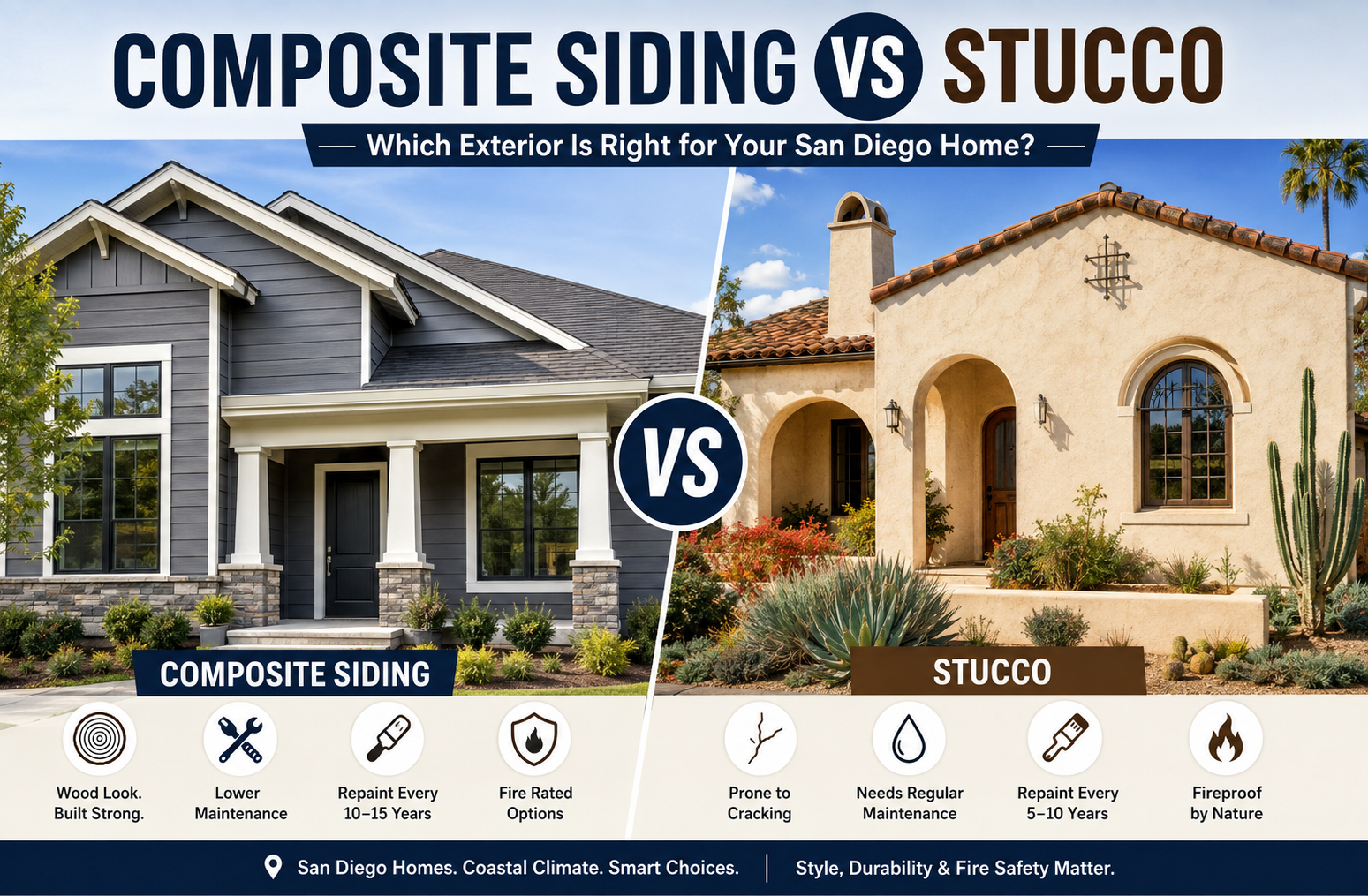
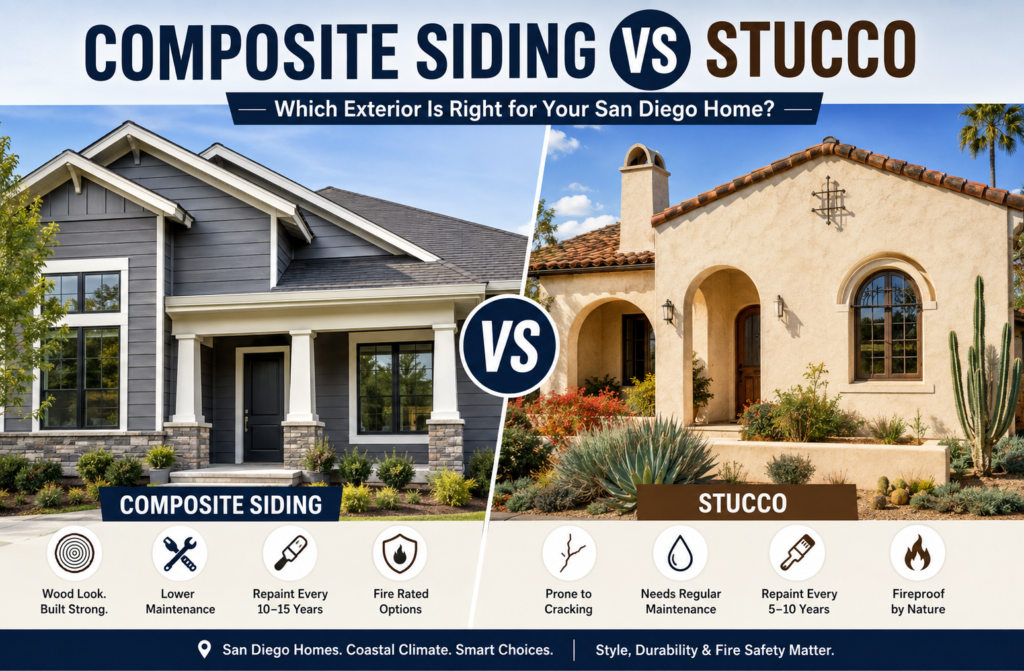
Drive around San Diego, and you will see the same thing on almost every house. Stucco, it has been the default here for hundreds of years.
But more homeowners are asking about siding now, usually when the stucco starts cracking, and a full re-coat is on the table anyway. If that’s you, here is an honest look at both.
So What is Composite Siding, Anyway?
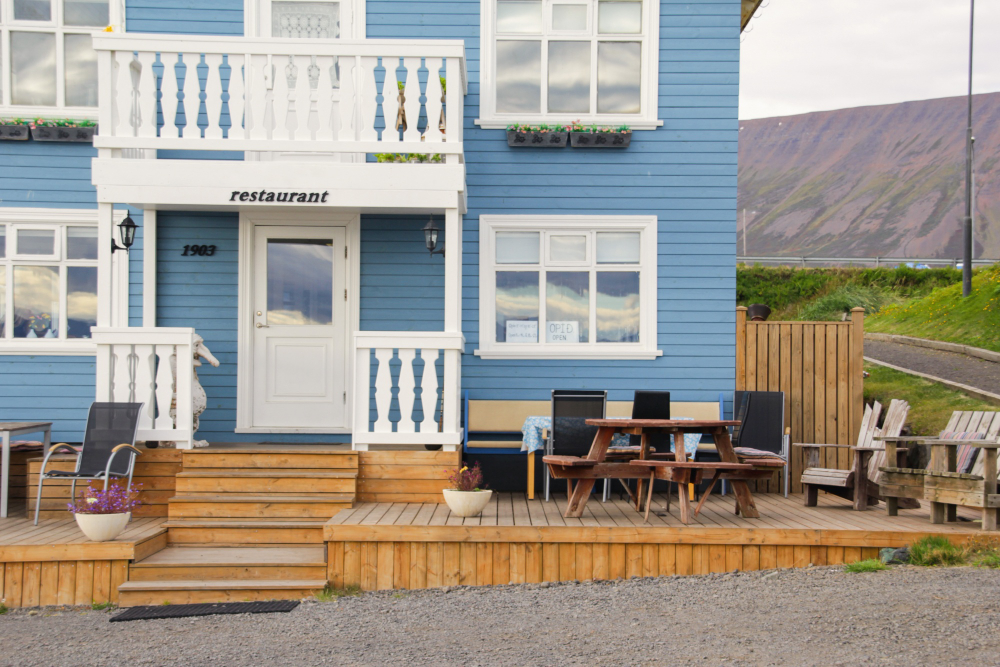
Composite siding is made from wood fibers mixed with resin and pressed into boards. You get the look of real wood without the rot, the bugs, or repainting every few years.
Some people call it engineered wood siding. Same thing.
There are so many brands you have probably seen. One thing to clear up. It is not the same as fiber cement, even though people mix them up all the time. Fiber cement is made from cement, sand, and wood pulp. It is heavier and more brittle. Different material.
Composite Siding Vs Stucco, Side By Side
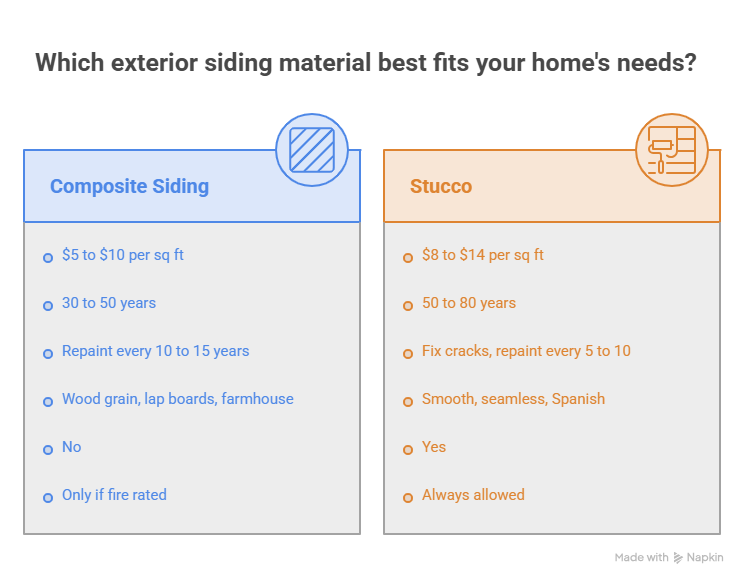
| Features | Composite Siding | Stucco |
| Cost installed | $5 to $10 per sq ft | $8 to $14 per sq ft |
| How long it lasts | 30 to 50 years | 50 to 80 years |
| Upkeep | Repaint every 10 to 15 years | Fix cracks, repaint every 5 to 10 |
| Look | Wood grain, lap boards, farmhouse | Smooth, seamless, Spanish |
| Cracks? | No | Yes, and that’s the big complaint |
| Fire zones | Only if the product is fire rated | Always allowed |
The composite siding cost looks cheaper on paper, and it is, but not by as much as the table suggests. Stucco is basically a water-related work that needs curing time between coats. Siding goes up faster with less labor. Once you compare full quotes instead of material prices, the gap gets smaller.
Why People Are Walking Away From Stucco
Stucco cracks. Not sometimes. Always.
The ground shifts, the house settles, and thin cracks show up within a few years.
Most of them are just cosmetic.
The problem is what happens next. Near the coast, those cracks let water get behind the wall. If the drainage layer underneath was not installed properly, you get rot you cannot see until it costs a lot to fix. That’s the reason behind most stucco lawsuits in California.
Siding deals with this differently. The boards move on their own, and water drains out behind them. If one board gets damaged, you swap that board instead of re-coating the whole house.
When Stucco Is Still The Right Call?
If your house is Spanish, Mediterranean, or Mission style, stucco wins. Nothing else gives you that smooth, seamless look, and siding on a Spanish home just looks wrong.
Stucco also does not burn. That matters more here than most people realize.
The Fire Zone Rule That Might Decide This for You
This is the part that can settle the whole question before you even pick a colour.
If your home sits in a Very High Fire Hazard Severity Zone, and a lot of inland San Diego County does, California requires your exterior walls to be fireproof or fire-resistant. Stucco passes automatically. Composite siding only passes if that exact product carries a State Fire Marshal fire rating.
So check your address on the CAL FIRE zone map before you fall in love with a material. If you are in one of those zones, your choices shrink fast, and fiber cement siding in San Diego becomes the sensible middle ground, since it resists fire on its own.
Vinyl vs Composite Siding, Quickly
People always ask, so here it is.
Vinyl is cheaper at $4 to $8 per square foot. It’s also thin plastic. It fades in our sun, warps in heat, and looks like plastic when you get close to it.
But the real issue with vinyl vs composite siding is fire. Vinyl melts, so you cannot use it in a fire zone at all. Composite is thicker, holds paint properly, and comes in fire-rated versions. The money you save is not worth it here.
What Ocean Air Does To Both
Salt air is hard on everything, but it goes after each material differently.
Stucco handles salt itself fine. What gets it is sprinkler spray, which leaves stains, and the tiny holes it develops over time that let water in.
Composite siding shrugs off salt too. Its weak spots are the nails and the cut ends of the boards, and that comes down entirely to who installs it. Stainless nails and sealed cuts, or you will have problems in ten years.
Homes in La Jolla and other spots near the water need that done right no matter which material you pick.
Which One Should You Pick?
Stick with Stucco if your home is Spanish or Mediterranean, if you are in a fire zone, or if your current stucco is solid and just needs patching.
Choose composite siding in San Diego if you want a craftsman or farmhouse look, if you are tired of chasing cracks every year, or if you like the idea of fixing one board instead of the whole wall.
Either way, this kind of work needs a permit and an inspection once the wall itself changes. Your contractor should be handling that, not you.
Get Someone To Look At Your Walls
The right answer comes down to your home’s style, your fire zone, and the real condition of what’s on your walls right now. That last one needs someone to come and see it.
Mel Development Inc. has been remodeling San Diego homes for twenty years, inside and out, including room additions and full exterior work. Licensed, insured, A+ with the BBB. Please go through our recent projects, then get in touch; we will give you a straight recommendation.
FAQ
Can I put siding straight over my stucco?
Usually the stucco has to come off first. You can strap over it, but that adds cost and makes the walls thicker around the windows, so most jobs start with removal.
Will siding hurt my home’s value in a stucco neighbourhood?
Not if it’s done well and suits the house. Good siding on a Craftsman looks like an upgrade. The same siding on a Spanish home looks like a mistake.
How long does the job take?
Two to four weeks for an average single-story home. Stucco takes longer because each coat has to cure.
Is composite the same as fiber cement?
No. Composite is wood fibers and resin. Fiber cement is cement, sand, and wood pulp. Fiber cement is heavier and resists fire on its own. Composite is lighter and easier to work with.